REVIEW · LOS ANGELES
Best of Downtown Los Angeles by Luxury E-Bike
Book on Viator →Operated by E Bike Tours LA · Bookable on Viator
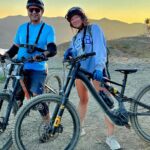
LA turns into playground on e-bikes. This Best of Downtown LA ride threads you from Atwater Village to Union Station and back, with car-free stretches, big bridge views, and a guide who gets you started fast on e-bikes.
I love how the route blends signature sights with real neighborhoods, from LA River crossings to the Brewery Arts Complex and then down to Chinatown. The one thing to think about is effort: you’ll want moderate fitness for the ride plus a few climbs, including a spiral staircase area.
In This Review
- Key highlights you’ll feel in the moment
- Why an e-bike makes downtown LA make sense
- Atwater Village start: your bike, your guide, and quick setup
- LA River bridges: from Red Car nostalgia to new bike-walk viewpoints
- Glassell Park to Lincoln Heights: alleys, tunnels, and a spiral over the 5
- Brewery Arts Complex and Stronghold: repurposed power plants meet art studios
- 6th Street Viaduct’s Ribbon of Light and the park under the arches
- Coffee break and the DTLA bridgehead: The Row and markets
- Street food, fashion bargains, and mosaic murals near El Pueblo
- El Pueblo, Olvera Street, and Avila Adobe: LA’s early core
- Union Station: art deco grandeur in a movie-famous setting
- Chinatown on Broadway, then back toward the hills
- Price and pacing: does $300 feel fair?
- Should you book this Downtown Los Angeles e-bike ride?
- FAQ
- How long is the Best of Downtown Los Angeles by Luxury E-Bike tour?
- What does the tour cost?
- What’s included in the price?
- Is lunch included?
- Where does the tour start and end?
- What’s the group size?
- What language is the tour offered in?
- How physically demanding is it?
- Do I get a ticket on my phone?
Key highlights you’ll feel in the moment
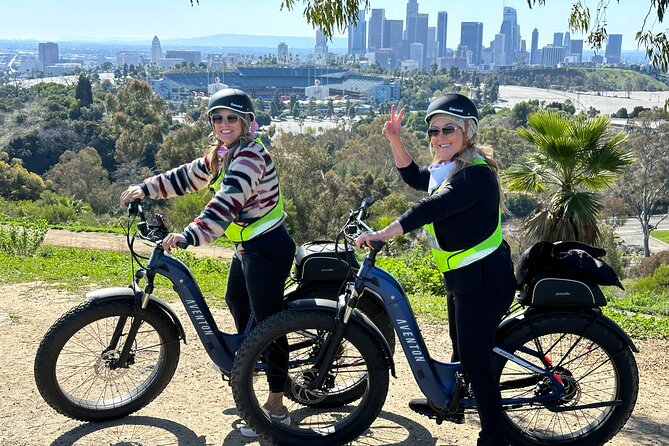
- Atwater Village bike-bungalow start: quick onboarding, safety gear, and the fun part, bikes with names
- LA River bridges with viewpoints: Red Car Bridge, Hyperion Bridge area, and the orange bike-walk crossing
- Artists’ District energy: Brewery Arts Complex studios, galleries, and repurposed industrial spaces
- 6th Street Viaduct’s Ribbon of Light: helical ramp access and the park beneath the arches
- DTLA classics without the traffic headache: Union Station, El Pueblo/Olvera Street, and Chinatown in one loop
Why an e-bike makes downtown LA make sense
Downtown Los Angeles can be tough to see by foot or by car. Distances are long, streets sprawl, and traffic can eat your time. This ride uses electric assist to keep you moving through neighborhoods instead of waiting at stops.
The big value here is pacing. You get guided stops for photos and short explanations, then you roll again while the city is still on your schedule. In my case, the route added up to about 25 miles without feeling like a full workout day, which is the sweet spot if you want variety but not pain.
Also, the tour is small. With a maximum of 6 people, you’re not fighting for attention at every corner. That matters when you’re threading through areas where bike lanes or detours are part of the reality.
You can also read our reviews of more cycling tours in Los Angeles
Atwater Village start: your bike, your guide, and quick setup
Most LA bike tours start in a parking lot. This one starts in a dedicated bike bungalow in Atwater Village, a neighborhood that feels like a break from the downtown swirl. It’s an easy walkable area for cafes and artisanal shopping before and after your ride.
Your guide meets you at the office, fits you with safety gear, and gets you comfortable on your e-bike. One fun touch: the bikes have names, so it’s easier to relax into the experience instead of thinking about handlebars the whole time.
If you like rides that feel organized but not stiff, this beginning sets the tone. You’ll get oriented and then you’re out into quieter streets quickly, not stuck lingering while everyone catches up.
LA River bridges: from Red Car nostalgia to new bike-walk viewpoints
The route really hits its stride along the LA River. You’ll enter the river corridor using the new car-free Red Car Pedestrian Bridge, named after the legendary Red Car Rail Trolleys that used to run over this stretch. It’s the kind of detail that turns a simple crossing into a story you can picture.
You’ll also hear why the LA River mattered long before it was a modern walking and bike corridor. In arid Southern California, the river was essential water for life, which is a reminder that Los Angeles didn’t grow in a vacuum.
From there, you’ll stand under the Hyperion Bridge. The guide shares that a replica shows up at Disneyland, and you’ll connect the area to Walt Disney. The details are specific: Disney lived nearby in Los Feliz while creating Mickey Mouse in his family garage, later started a studio in Silver Lake, and was a regular at the Tam O’Shanter (Table 31) in Atwater Village. That kind of local grounding is what makes the river section feel more than just scenery.
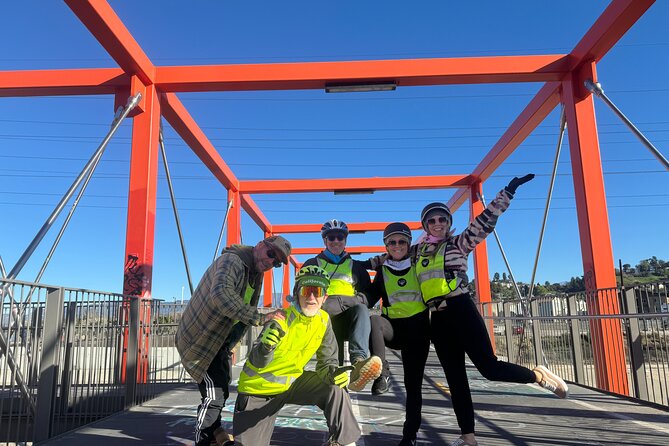
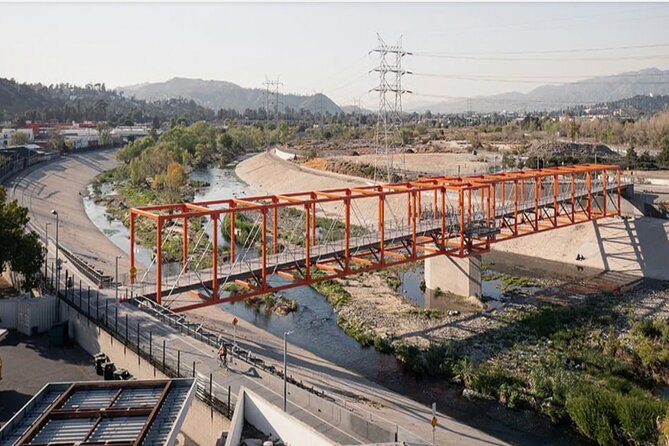
Next comes the eight-mile Glendale Narrows stretch and a bright orange bike-walk bridge. It’s designed exclusively for pedestrians and bicyclists, with two viewing platforms (belvederes) that open up north and south views. It’s also part of the River Revitalization Master Plan, with future connections planned toward the Taylor Yard G2 River Park.
Practical note: bridge areas often mean stops are short and the pace is steady. If you want long museum-style time, this isn’t that kind of tour. It’s designed for movement and quick, meaningful stops.
Glassell Park to Lincoln Heights: alleys, tunnels, and a spiral over the 5
After the river, you switch from wide-open views to the city’s more gritty, in-between spaces. In Glassell Park, you’ll weave through back alleys and traffic tunnels and pass a backstreet pop-up flea market. Even with the bike path doing most of the work, this stop helps you see LA’s personality beyond the postcard spots.
Then you reach Lincoln Heights, where the ride includes your first spiral staircase moment over the 5 freeway. Spiral staircases are never just architecture. They change how the space feels, and they make you pay attention to where the city goes up and down.
You’ll also skirt the edges of Dogtown as you head toward the Brewery District. That shift is important: the route doesn’t only chase “famous.” It also shows the rougher transitions that make neighborhoods feel real.
Brewery Arts Complex and Stronghold: repurposed power plants meet art studios
The Brewery Arts Complex (also called the Brewery Art Colony) is one of the reasons this tour feels different from a standard highlights loop. It’s a large live-and-work artists’ compound built across 16 acres and 21 former warehouses. You’ll hear about a former Edison power plant chimney dating to 1903, and you’ll see how industrial leftovers became studio spaces.
The scale matters here. The complex covers work studios, living lofts, restaurants, and galleries. More than 100 studios are open to the public during Brewery Art Walk periods, which tells you that this isn’t only a pretty photo stop. It’s a working creative district where art is part of daily life.
Right inside this broader complex, you’ll also pause at The Stronghold Climbing Gym. The Stronghold sits within the 23-acre Brewery complex and is housed in an old Pabst Brewing facility alongside the older California Edison Los Angeles Steam Power Plant. That blend of repurposed industry and modern activity is the point: LA keeps reusing and reinventing.
If you’re traveling with people who love either art or active fun, this portion works because it gives both. If you prefer strict historic landmarks, you might like it less, but it still offers context for how the city adapts.
You can also read our reviews of more tours and experiences in Los Angeles
6th Street Viaduct’s Ribbon of Light and the park under the arches
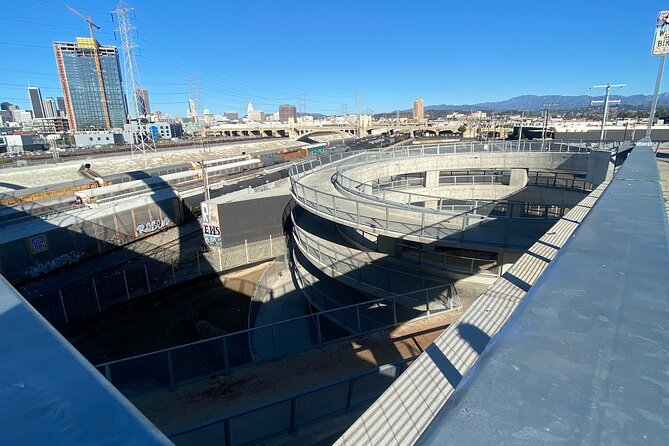
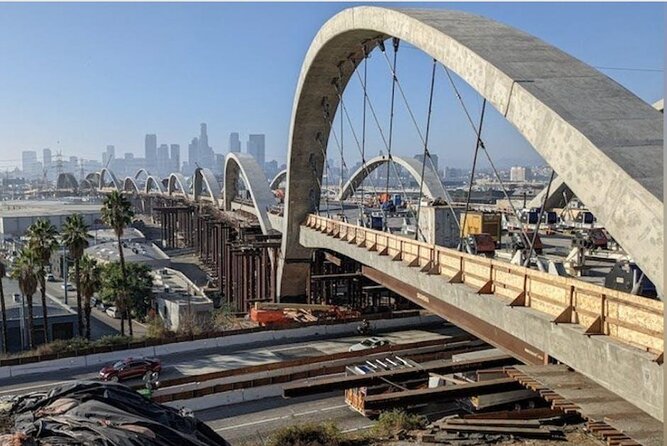
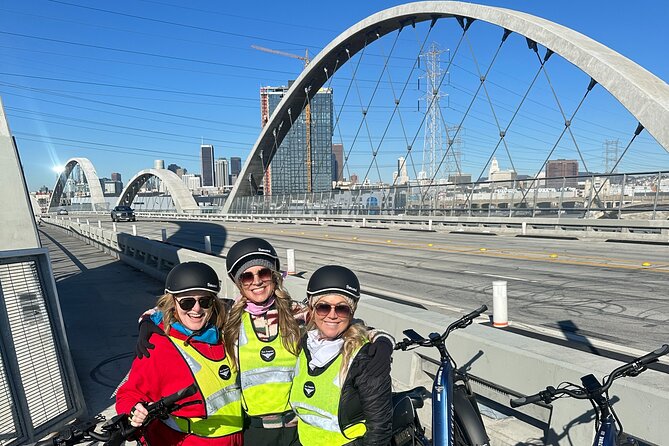
The 6th Street Viaduct is one of those places where the architecture looks like it was designed for motion. It’s called the Ribbon of Light, paying homage to an original 1932 bridge known from films and TV.
The new design uses 10 pairs of sculptural arches. The tallest pairs sit near and frame the LA River where the original arches stood, and another taller set spans US101 as a gateway on the east. In other words, it’s not just a bridge. It’s a visual marker for the neighborhood and the river corridor.
Access is part of the show: you’ll get to the bridge via a monumental helical bike ramp. Think of it as a bike-friendly architectural stairway, a moment where your route becomes a ride.
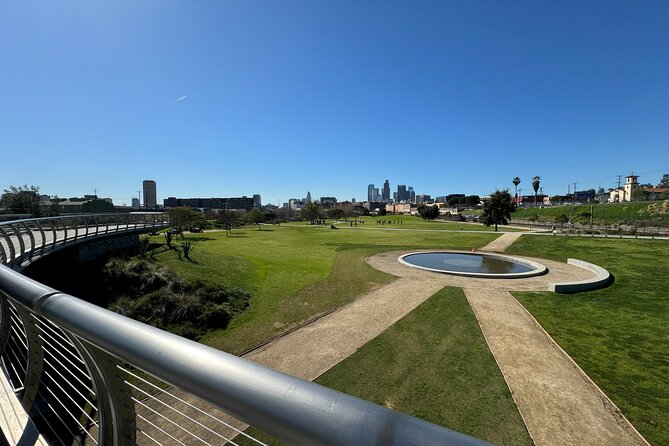
Beneath the bridge, you’ll reach a new 12-acre public park with fields, restrooms, and a café. It also connects you toward the river plus public art and an arts plaza. If you like cities that build spaces for hanging out, this is one of the best stretches on the day.
Coffee break and the DTLA bridgehead: The Row and markets
After the viaduct, you’ll take a coffee break at Blue Bottle Coffee along Mateo Street. The tour data doesn’t say coffee is included, so plan on buying your own if you want it. Still, having the pause scheduled matters, especially with a long ride day ahead.
Then you roll into The Row DTLA, a mixed-use area sitting over 30 acres. You’ll hear about 100 retail stores and restaurants, plus commercial workspace totaling about 1.3 million square feet. The big draw for many people is the 7th Street Produce Market inside it.
That market has been established since 1917, and every Sunday it becomes Smorgasburg. Even if you’re not there on Sunday, this stop gives you a sense of how food culture anchors DTLA.
Practical note: this section is more about urban energy than quiet views. Expect more people and more commercial storefront cues.
Street food, fashion bargains, and mosaic murals near El Pueblo
The ride turns into food and shopping mode for a reason. You’re not only seeing architecture; you’re seeing how locals actually spend time.
In the Piñata District, the tour includes a stop for street food lunch. You might see choices like pupusas or tacos, plus traditional fermented Mexican drinks like tepache and pulque. Lunch isn’t included, so treat this as a chance to pick what fits your appetite and budget.
Next, you pass through the Fashion District, the West Coast hub for the apparel industry. Even if you’re not shopping, it helps to understand why this whole area feels like a production and retail engine.
Then comes Santee Alley, described as a bargain hunter’s paradise with 150+ retailers. It’s an overload in the best way: sunglasses, sneakers, shirts, sequins, and snack stops all in one long corridor. If you’re the type who likes to browse for small souvenirs, this is where you’ll likely spend time.
After the shopping energy, the tour pauses at the Federal Building, known for two huge mosaic murals: Celebration of our Homeland and Recognition of All Foreign Lands, both 26 feet tall. It’s a strong contrast to the alley chaos, giving you a calmer, more reflective moment.
El Pueblo, Olvera Street, and Avila Adobe: LA’s early core
Now you shift into the historic center around El Pueblo de Los Angeles. This is the spot where 44 settlers of Native American, African, and European heritage arrived from Mexico in 1781 and founded the village that grew into modern LA.
The ride then heads into Calle Olvera, the colorful Mexican marketplace where huarache sandals, embroidered blouses, woven blankets, and mariachi music all tie together the lively plaza vibe. Even a short pause here gives you more of the “old LA” feel than you get from skyline views.
Right after that, you stop at Ávila Adobe, built in 1818 by Francisco Ávila. It’s the oldest standing residence in the city of Los Angeles. The building itself is a California Historical Landmark, and the surrounding historic district ties into the National Register of Historic Places plus Los Angeles Historic-Cultural Monument designations. Short time here, but the layers show quickly.
This whole section works well for first-time visitors because it connects early settlement to present-day cultural identity without pretending LA is only one era.
Union Station: art deco grandeur in a movie-famous setting
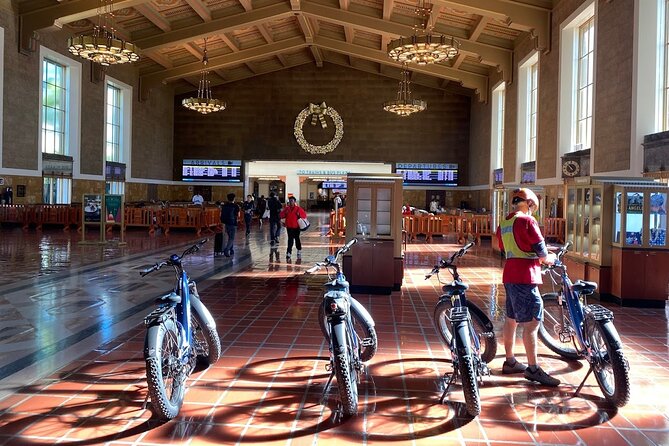
Next up is Union Station, one of the most impressive stops on the whole day. It’s widely known as the last of the great train stations, with decadent art deco design. The station opened in May 1939 and is the largest passenger rail terminal in the Western United States.
Here’s the fun part for movie lovers: Union Station has shown up in lots of productions, including Blade Runner, Catch Me If You Can, Pearl Harbour, Dark Knight, Speed, and Euphoria. You might not catch film trivia in the signage, but once you see the spaces, those references make sense.
Even if you don’t care about movies, Union Station is still a high-value stop because it’s a place designed for arrival and departure. That feel translates well to a bike tour day, when you’re moving through chapters of the city.
Chinatown on Broadway, then back toward the hills
After Union Station, the tour moves into Chinatown, where the Chinatown Gateway Monument shows twin golden dragons. You’ll learn that this area welcomed the first Chinatown in the U.S. owned by Chinese residents, and you’ll see shop streets along Broadway with fresh produce, straw hats, toys, and housewares.
The art cues here are specific: the Dragon Chasing Pearl mural and a statue of martial arts star Bruce Lee. You’ll also get a quick timeline about how the original Chinatown was demolished to make room for Union Station, and how “New Chinatown” opened for business in 1938. That story adds weight to what otherwise might feel like a fast stop for browsing.
Then the ride heads up into Elysian Park, founded in 1886 and described as the city’s oldest park. You get sweeping views over Dodger Stadium, the San Gabriel Mountains, Los Angeles, and out toward the Pacific Ocean. If you want a payoff after hours in the city grid, this is where it arrives.
Finally, you end with Elysian Valley, also known as Frogtown. The vibe here is creative—bike paths, art studios, and restaurants—and it’s a fitting last chapter before you return.
You’ll come home via the LA River and the Red Car Bridge again, which is smart route design. A return on the same corridor helps the day feel like one continuous story instead of disconnected miles.
Price and pacing: does $300 feel fair?
At $300 per person for about 4 to 5 hours, this is not a bargain. But it also isn’t trying to be. You’re paying for an e-bike experience with a guide, safety setup, snacks, and bottled water, plus a route that pulls together multiple major neighborhoods and bridge sites without relying on traffic-heavy transit.
You also get a small maximum group size of 6, which makes the guidance more personal and the pace more controlled. For many people, that alone is part of the value, especially if you’re not an experienced rider.
Another detail worth your time: the tour is often booked far ahead, with an average booking window of 99 days. If your trip dates are fixed, I’d plan on reserving early rather than waiting for the last minute.
What you should bring or plan for:
- You’ll want clothing for sun and shade changes on bridges and open stretches.
- Lunch is not included, and coffee is optional, so keep a budget for food stops.
- You should be comfortable with moderate effort and a few climbs, including spiral-staircase areas.
Should you book this Downtown Los Angeles e-bike ride?
Book it if you want LA in one day without the usual compromises. This is a great match for first-timers, couples, and families who want big-name spots plus local texture, especially if you enjoy mixing architecture, art districts, and food neighborhoods. The guide experience matters too, and the ride is guided with a focus on safety and fun, with humor baked into the pacing.
Skip it (or at least reconsider the timing) if you want long indoor museum time, or if you prefer totally flat terrain. You’ll ride through active parts of the city and hit a few climb moments, so it’s better seen as an energetic city outing than a leisurely stroll.
If you do book, show up with the mindset that this is a guided ride first and a sightseeing tour second. You’ll get more out of it when you let the e-bike do the heavy lifting and enjoy the bridges, neighborhoods, and stories as you pass through them.
FAQ
How long is the Best of Downtown Los Angeles by Luxury E-Bike tour?
It runs about 4 to 5 hours.
What does the tour cost?
The price is $300.00 per person.
What’s included in the price?
You get bicycle use plus snacks and bottled water.
Is lunch included?
No. Lunch is not included, though you’ll have food and drink opportunities during stops.
Where does the tour start and end?
You meet at E Bike Tours Los Angeles, 3306 Glendale Blvd #2, Los Angeles, CA 90039, USA, and the ride ends back at the meeting point.
What’s the group size?
The maximum group size is 6 travelers.
What language is the tour offered in?
The tour is offered in English.
How physically demanding is it?
You should have a moderate physical fitness level for the ride.
Do I get a ticket on my phone?
Yes, it uses a mobile ticket. Confirmation is received at the time of booking.