REVIEW · LOS ANGELES
Los Angeles Arts District Bike Tour
Book on Viator →Operated by Handlebar Bike Tours LLC · Bookable on Viator
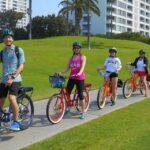
Murals and murals alone are fun. This one adds a bike route. You get a half-day ride through LA’s Arts District with live, amplified commentary on artists, murals, galleries, and how the neighborhood grew—plus a hop into Little Tokyo along the way.
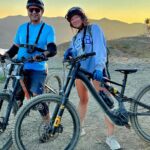
Two things I really liked: the ride feels safe and approachable for most people, and the guide keeps the stops grounded in what you’re actually looking at, not just random trivia. When I pictured doing a street-art tour, I wanted it to feel respectful and specific, and that is exactly the tone—my guide Jen especially stood out for being patient and setting a calm pace.
One consideration: you need to be comfortable riding a bike in city streets, and the tour depends on good weather. Also, there’s no food included, so plan snacks or a post-ride meal at the meeting-point food hall.
In This Review
- Key things to know before you pedal
- A 2.5-hour Arts District ride that feels made for real looking
- Starting at 312 S Hill St: Handlebar’s food-hall home base
- The Arts District in motion: alleys, lofts, and graffiti you can actually study
- Angel City Brewery and the quick culture check
- Firehouse Hotel area: where graffiti, chefs, and TV-music vibes overlap
- Hauser & Wirth: a gallery break you can use well
- The mural concentration stop: learning the artists and the process
- American Hotel and the birth-story feeling of the Arts District
- Cutting through Little Tokyo: the link to Los Angeles history
- Below-market studio mission: why this district stays artist-shaped
- Ride-by moments: clubs, studios, hotels, and production spaces
- 6th Street Viaduct: the skyline photo moment
- Price and value: why $82 can be a bargain here
- Pacing and fitness: easy ride, but not a Sunday stroll
- What to bring so the afternoon goes smoothly
- Should you book the Los Angeles Arts District Bike Tour?
- FAQ
- FAQ
- How long is the Los Angeles Arts District Bike Tour?
- What does the tour cost?
- What’s included in the price?
- Is the tour offered in English?
- Is food included?
- What kind of bike experience do I need?
- What happens if the weather is bad?
Key things to know before you pedal
- Small group (max 10) keeps the ride feeling personal and not chaotic
- Bike + helmet included, plus live amplified guide commentary throughout
- Arts District murals are the main event, with time built in to actually look and learn
- Hauser & Wirth gets a real break (explore on your own for about 20 minutes)
- Little Tokyo link is intentional, not a random detour
- A mix of ride-by moments and short stops, so you stay moving without missing key art
A 2.5-hour Arts District ride that feels made for real looking
The best part of this tour is that it doesn’t rush past the street art like it’s wallpaper. You slow down enough to see technique—brushwork, layering, scale, and the way murals sit inside an industrial neighborhood. Then you balance it with breaks that let you regroup, take photos, and read the spaces as places, not backdrops.
The whole experience is built around a 2:00 pm departure and roughly 2 hours 30 minutes on a bike. That timing matters in Los Angeles. Afternoon rides give you daylight for color and detail, while still leaving you time to keep exploring on your own afterward.
And because it’s capped at 10 travelers, you’re not fighting for attention or trying to hear the guide over a crowd. The amplified commentary helps a lot, especially if you’re biking and can’t constantly turn your head.
You can also read our reviews of more cycling tours in Los Angeles
Starting at 312 S Hill St: Handlebar’s food-hall home base
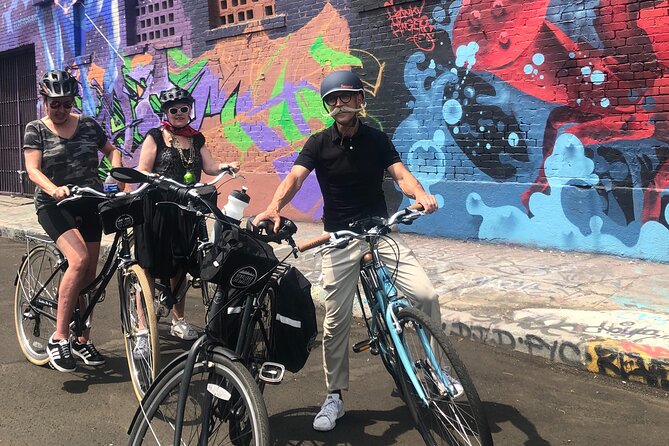
Meeting at 312 S Hill St is one of those quietly smart choices. It’s near public transportation, so you’re not dependent on driving. And the tour starts at Handlebar Bike Tours at a 100-year-old food hall that has 45+ vendors—meaning you can snack before you ride or celebrate after.
That also gives you an easy way to shape the day. If you arrive early, you can grab coffee or something light and get your bearings. If you’re hungry after the ride, you’re right where you need to be for dinner without hunting down parking or switching neighborhoods.
Practically, this matters because the tour includes no food. So having a nearby, walk-in option makes the whole thing less stressful.
The Arts District in motion: alleys, lofts, and graffiti you can actually study
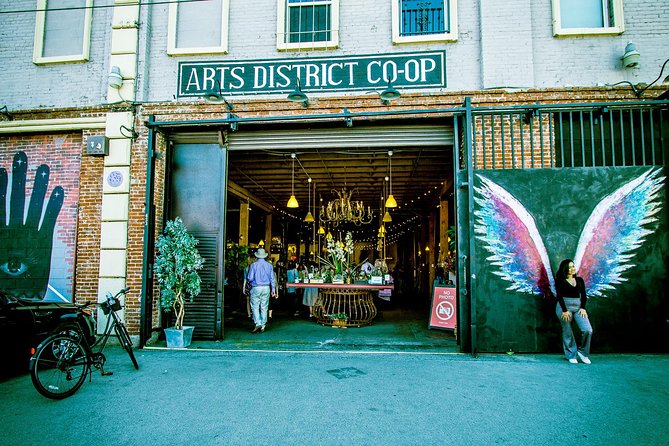
Once you roll out, the neighborhood starts doing what it does best: mixing art with everyday industry. You’ll see artists’ lofts tucked among industrial buildings, plus alleyways where graffiti writing and street culture live right alongside newer restaurants and pop-up scenes.
One part I’d pay attention to: the route is designed to show you pieces and corridors that many classic, bus-style tours don’t spend time on. Instead of only stopping at the biggest, most obvious walls, you’re guided through the working texture of the district—where new art keeps showing up and the neighborhood still feels like it’s in process.
During this stretch, the guide’s job is more than pointing. The commentary ties the art to artists and production—how a wall gets transformed, and why the work matters in a place where artists are still part of the community.
Angel City Brewery and the quick culture check
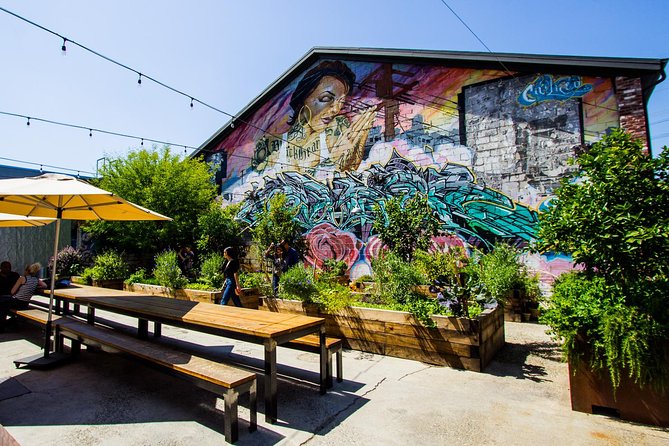
The tour includes a short stop at Angel City Brewery, described as an unofficial gateway to the Arts District, with local artists’ work decorating the space. You’re not meant to turn it into a long tasting session. Think of it as a reset moment.
This kind of quick, focused pause is useful on a bike tour. You get a chance to step off the saddle, rehydrate, and use the moment to frame what you’re going to see next—especially when the route keeps shifting between murals, studios, and gallery zones.
If you do want beer or a snack, plan for that extra spend, since it’s not listed as included.
Firehouse Hotel area: where graffiti, chefs, and TV-music vibes overlap
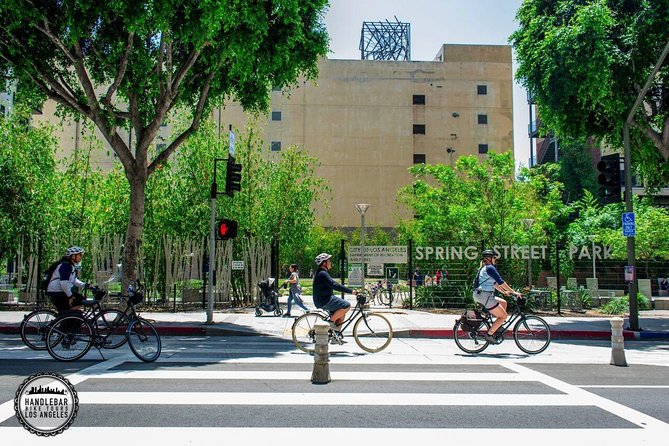
Next you ride into the area around the Arts District Firehouse Hotel, where you’ll see graffiti writing and get a feel for how street art culture sits near polished dining and creative businesses. The description also mentions Warner Brothers Music connections and star chef restaurants nearby.
This stop is a good example of why a guided bike tour can outperform a self-walk. On your own, you might spot the artwork but miss the connections the guide highlights—how different creative industries share space and influence the look and feel of the streets.
You’re not just collecting photos. You’re learning what makes the neighborhood’s “street-to-industry” mix so specific.
Hauser & Wirth: a gallery break you can use well

The tour builds in an about 20-minute break at Hauser & Wirth, letting you explore the expansive gallery complex on your own. This is one of the better-designed pauses on the route, because it’s long enough to walk around without feeling rushed, but short enough that the momentum of the day doesn’t fade.
What you should do during this time:
- Take a slow lap first, so you see how the indoor space frames art differently than the street walls
- Then go back to areas that connect to what you just learned outside—scale, materials, and the role of artists in shaping public vs. private viewing
The tour then returns you to the open-air portion of the day, where the murals take over again.
The mural concentration stop: learning the artists and the process
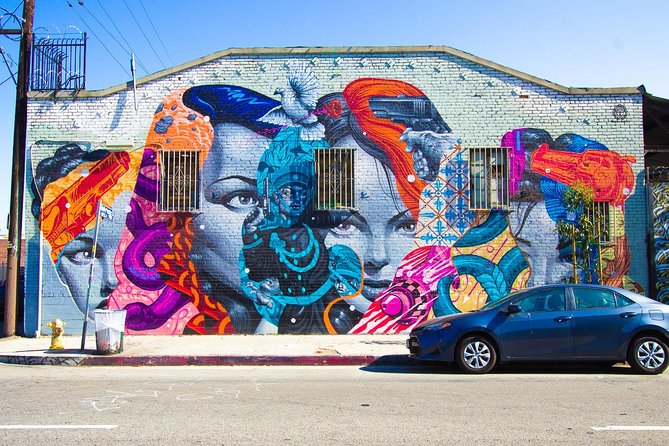
A key highlight is a stop described as having the largest concentration of murals and street art in Los Angeles. This is where you’ll learn about the artists, the process, and production—basically, how these walls become museum-worthy in real time.
This also is where the tour’s attitude matters. The commentary emphasizes respecting the culture of street artists and the residents who live near the art. That matters because street art is not the same as a curated museum wall. It’s part of a living neighborhood, and the tour approach reflects that.
If you care about street art beyond the look—if you want to understand effort, decisions, and why certain styles show up here—this is the portion that delivers.
American Hotel and the birth-story feeling of the Arts District
You also stop at The American Hotel, described as the birthplace of the modern Arts District. That framing helps you connect what you see now with what the neighborhood used to be.
On a bike, it’s easy to forget that you’re moving through change. This stop makes the change feel legible. You get a sense of why warehouses and industry became creative space, and how the district earned its identity instead of just being packaged as an art zone.
Cutting through Little Tokyo: the link to Los Angeles history
Getting into Little Tokyo isn’t just about variety. The tour uses the area to explain how history interlocks between Little Tokyo, the Arts District, and Los Angeles overall.
On the way, you’ll ride through Little Tokyo and it’s described as full of sushi, anime, and ramen. When galleries are closed, this area also becomes the logical break point—another practical detail that keeps the tour moving without forcing you to wait around.
The tour also includes stops tied to the Japanese American community, including the Japanese American National Museum area. You’ll see the Museum of Contemporary Art and the Go For Broke Monument, then hear how Little Tokyo’s story threads into the bigger Arts District picture.
This portion is valuable because it expands the tour beyond street murals alone. It gives you context for why creativity and community support matter in the same city spaces.
Below-market studio mission: why this district stays artist-shaped
One stop centers on a non-profit providing below-market live work studios to keep artists in the Arts District. This is a detail I love because it reframes street art as more than decoration.
If murals only appeared because artists were temporarily touring with spray cans, the vibe would be different. But when artists have a way to stay—through lower-cost live/work options—the neighborhood’s look evolves in a more continuous, grounded way.
On this tour, that kind of stop helps you understand what you’re seeing isn’t just a pastiche. It’s supported by real structures.
Ride-by moments: clubs, studios, hotels, and production spaces
The route includes several short, quick moments that are more about feeling the neighborhood than stopping for a long visit.
You’ll ride by:
- Cool clubs that are described as under-the-radar
- Bestia, one of the chef-driven restaurants in the Arts District (mostly a passing moment)
- Willow Studios, production studios in the district
- Soho Warehouse, described as a celebrity enclave near railroad tracks in East L.A.
These are the spots where you start to feel the district’s dual personality: street-level art culture on one side, and creative business spaces on the other. Even if you never step inside, the guide’s framing helps you see why these businesses exist here and how the district’s image got built.
6th Street Viaduct: the skyline photo moment
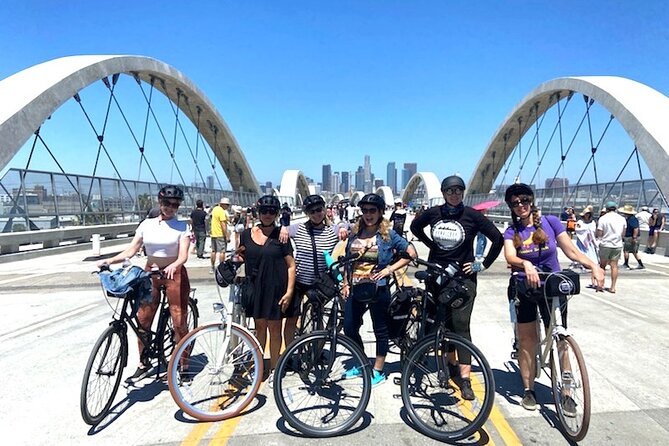
Another included highlight is the 6th Street Viaduct, where the tour includes admission. It’s also a known LA film location, and it’s featured more and more often as a movie/TV backdrop.
This is a good closer or near-closer because it gives you:
- A big-structure view after all the murals at street level
- A photo moment with context—bridges, skyline, and the grid of downtown behind it
Think of it as the visual reward for paying attention all afternoon.
Price and value: why $82 can be a bargain here
At $82 per person, this isn’t the cheapest bike tour in Los Angeles. But the value stack is unusually strong for what you get.
Here’s why it can feel like good money:
- You get a bike and helmet included, so you’re not paying separately to rent equipment
- You get a live amplified guide, which is the difference between seeing art and actually understanding it
- Most stops are listed as ticket free, which keeps the cost from creeping up
- 6th Street Viaduct admission is included, so you’re paying for at least one structured attraction element
- The group size is small, which usually means you get more time and attention per person
If you’re already planning to rent a bike and pay for a guided walk, the math gets easier. And if you want a tour that connects murals to neighborhood history and culture (not just photo ops), the guided commentary is the core value.
Pacing and fitness: easy ride, but not a Sunday stroll
The tour is described as an easy ride suitable for most people, and it’s mostly flat. Still, it’s not labeled as beginner-bike training.
You should be ready for:
- Riding on city streets (traffic, crossings, and normal urban surprises)
- Moderate physical fitness for about 2.5 hours
- Staying comfortable in an active afternoon schedule
Minimum age is 12, and you need to know how to ride a bike. If your comfort level is low, you might find it stressful even if the route is considered easy.
What to bring so the afternoon goes smoothly
You’ll get the bike and helmet, so you’re not starting from scratch. But do bring the basics:
- Water (especially since the tour doesn’t include food)
- Sun protection (Los Angeles will remind you it’s Los Angeles)
- A light layer if you get chilly later in the day
- A phone for photos, because you’ll want to capture mural details and the Viaduct area
If you’re sensitive to crowds, choose calmer photo moments at stops—time is short at several points, so the guide pacing helps, but you still have to manage your own photo timing.
Should you book the Los Angeles Arts District Bike Tour?
Book it if you want a mural-focused day with structure and context, and you like the idea of learning while you ride. This is also a smart choice if you prefer a smaller group and don’t want a rushed bus-tour feel.
Skip it or think twice if you:
- Don’t feel confident riding on city streets
- Want a tour that includes food or a long gallery time
- Are traveling during a weather window that’s questionable, since the tour requires good weather and you’ll need a plan if conditions change
If your goal is to understand why the Arts District looks the way it does—artists, murals, studios, and the neighborhoods next door—this tour hits the right balance of art and practical pacing.
FAQ
FAQ
How long is the Los Angeles Arts District Bike Tour?
It runs for about 2 hours 30 minutes.
What does the tour cost?
The price is $82.00 per person.
What’s included in the price?
You get use of a bicycle and a helmet, plus a live amplified guide.
Is the tour offered in English?
Yes, it’s offered in English.
Is food included?
No. The tour does not include any food.
What kind of bike experience do I need?
You should know how to ride a bike and be able to ride on city streets. The ride is described as easy and suitable for most people, but it is still an active street-bike experience.
What happens if the weather is bad?
The experience requires good weather. If it’s canceled due to poor weather, you’ll be offered a different date or a full refund.