REVIEW · LOS ANGELES
The History and Architecture of Downtown Los Angeles
Book on Viator →Operated by See LA in a Day · Bookable on Viator
Downtown LA tells stories on foot. This 3-hour walking tour uses landmark architecture, civic history, and real neighborhood food stops to show how Los Angeles grew from Victorian-era patches into a modern city center. You’ll cover the Historic Core, Civic Center, Bunker Hill, and Little Tokyo with a local guide who keeps the pace friendly and the details sharp.
I especially love two things: the mix of free major sites and the small-group feel (up to 15 people), which makes it easy to ask questions. You also get a standout food moment in Little Tokyo, including a traditional Japanese snack from Fugetsu-Do.
One thing to consider: Downtown LA is a lot of walking and some stretches can feel hot, so plan for good weather and bring water (and, honestly, a hat).
In This Review
- Key highlights worth planning around
- Getting your bearings on Angels Flight Railway and Bunker Hill
- Bunker Hill’s free art stops: MOCA and The Broad
- Walt Disney Concert Hall and City Hall: where civic power meets star architecture
- Little Tokyo: history, food, and Fugetsu-Do mochi
- St. Vibiana and Broadway’s movie-palace era on a walk
- The Bradbury Building and the Spring Street bank district timeline
- The Last Bookstore and Grand Central Market: closing with real LA taste
- Price, pacing, and what $39.20 buys you in 3 hours
- Who should book this Downtown LA architecture and history tour
- Should you book it?
- FAQ
- How long is the Downtown Los Angeles history and architecture tour?
- How much does the tour cost?
- What’s included in the tour?
- Are there any admission fees during the tour?
- Where does the tour meet?
- What language is the tour offered in?
- Is it a small group?
- Is the tour weather-dependent?
Key highlights worth planning around
- Angels Flight Railway included at the start, with the route explained as part of Bunker Hill’s Victorian story
- Free art stops in Bunker Hill, including Museum of Contemporary Art and The Broad
- Frank Gehry’s Walt Disney Concert Hall plus civic history around City Hall and Grand Park
- Little Tokyo food included, with mochi at Fugetsu-Do
- Historic stops with photo value, like the Bradbury Building and the Million Dollar Theater area
Getting your bearings on Angels Flight Railway and Bunker Hill
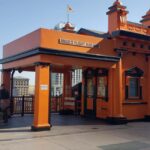
The tour begins at 341 S Hill St, and the first big moment is Angels Flight Railway. This is not just a quick ride—it’s a visual primer on how steep Downtown LA really is and how Bunker Hill’s Victorian-era community fit into that geography. You’ll learn why a short funicular line mattered so much back when this area was living, not just existing between other attractions.
Angels Flight also works as a mental reset. Right away, you stop thinking of Downtown LA as a single grid of streets and start seeing it as a set of layers—elevation, neighborhoods, and eras stacked on top of each other.
And yes, the ticket for the ride is included, so you’re not left doing math in your head five minutes into the tour.
You can also read our reviews of more walking tours in Los Angeles


Bunker Hill’s free art stops: MOCA and The Broad
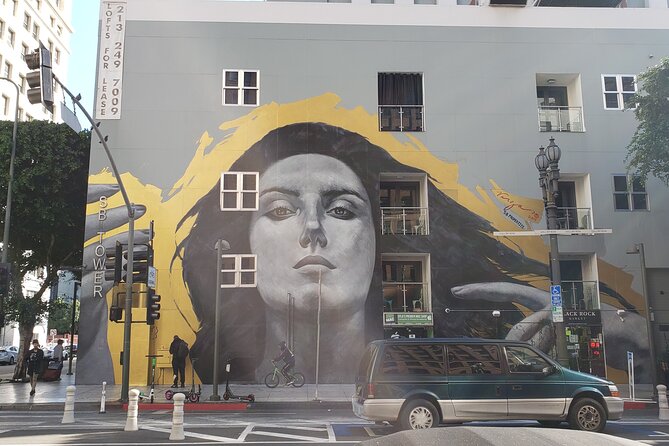
From Angels Flight, the route swings into Bunker Hill, where art and architecture share the same air. Two stops are especially handy if you want big “LA moments” without spending extra money.
First is the Museum of Contemporary Art (MOCA). The story here isn’t only about what you might see inside—it’s about the architect behind the building and the early struggles that shaped it. Even on a quick stop, that context changes how you look at the structure outside.
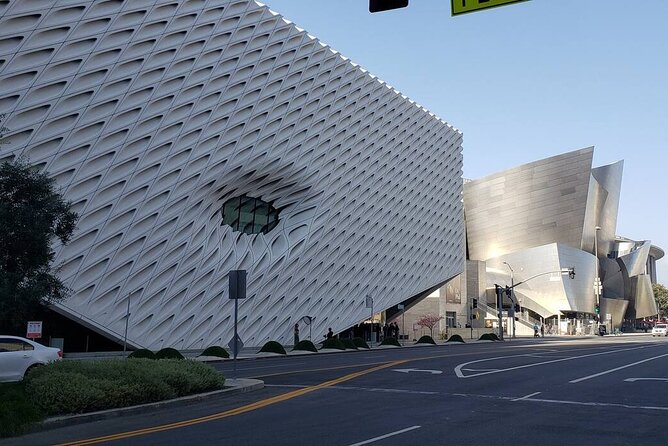
Then you hit The Broad, another major name with free admission. The guide will help you with the pronunciation (it’s one of those words people mess up on day one), and the real point is how the building and the Pop Art collection work together. You’ll get that rare feeling where the art and the architecture are both doing their job.
If you’re trying to choose between “museum time” and “walk and learn time,” this tour’s format does both. You get just enough time at each place to make them feel meaningful, not rushed.
Walt Disney Concert Hall and City Hall: where civic power meets star architecture
Next up is Walt Disney Concert Hall, designed by Frank Gehry. This is one of those buildings you can understand without a long lecture: the angles, the curves, the metallic shimmer—every view seems to change depending on where you stand.
What’s practical for you is how the tour frames the hall. Instead of only listing design facts, it focuses on why the building’s creation was so fascinating. That kind of behind-the-scenes angle helps you “read” the building like a design puzzle while you’re actually looking at it.
From there, the tour moves into the civic heart of Downtown around City Hall and Grand Park. The emphasis here is on how Los Angeles grew—how it went from a town of about 44 to a city of millions. Walking through Grand Park in the middle of those stories makes the scale feel real.
This section is great if you’re the type of traveler who likes knowing what’s behind the headline. LA’s architecture isn’t just pretty. It’s a record of ambition, politics, and changing priorities.
Little Tokyo: history, food, and Fugetsu-Do mochi
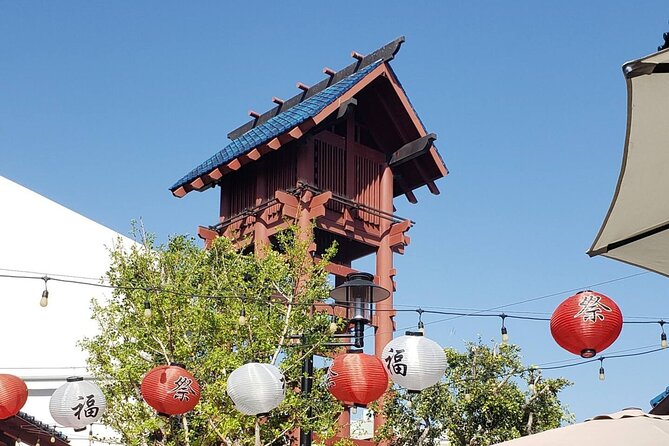
Little Tokyo is one of the best parts of the day because it’s not treated like a theme park. The tour explains how Japanese communities shaped California and how Los Angeles shows that legacy in everyday life—businesses, historic markers, and the neighborhood’s ongoing energy.
You get about 30 minutes here, and that’s long enough to actually look around. The guide points out places that matter, plus food recs so you can keep exploring after the tour ends.
Then comes the highlight snack stop: Fugetsu-Do. This is a family business that has operated since 1903, and the tour connects that endurance to a sweeping timeline of events, including two world wars and the Great Depression. The payoff is mochi—simple, comforting, and a great way to taste the neighborhood’s staying power.
If you want one reason this tour stands out for first-time LA visitors, it’s that it pairs history with a real food stop you can’t easily recreate on your own without knowing what to look for.
St. Vibiana and Broadway’s movie-palace era on a walk
After Little Tokyo, the route heads toward older LA through historic buildings.
One stop is St. Vibiana’s Cathedral from 1876. The point of the stop isn’t just that it’s old—it’s that you get a sense of how people gathered in earlier Los Angeles. The tour frames it with the scale of the city at the time, including the idea that roughly a fifth of LA’s population could fit inside when it was built. That’s the kind of detail that makes a preserved building feel less like a relic and more like a snapshot of real life.
Then the tour moves along the Broadway “movie palace” corridor, where Downtown LA still has a rare concentration of ornate theaters. The Million Dollar Theater is singled out, including its role in premieres and its grand design as one of the still-standing treasures of the era.
This part works well because architecture and entertainment are linked. These were big public spaces, built to impress, and the building style reflects that purpose.
You can also read our reviews of more historical tours in Los Angeles


The Bradbury Building and the Spring Street bank district timeline
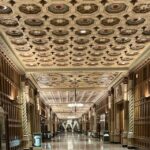
If you want one building that feels like LA’s imagination made stone, it’s the Bradbury Building. The tour treats it like more than a photo stop, sharing the story of this 1893 masterpiece. Even if you’ve seen pictures before, it lands differently when someone explains why it’s famous and what makes the interior and design special.
From there, you’ll walk through the old bank district along Spring St, and this becomes an architectural timeline in motion. The tour highlights how wealth and ambition shaped Downtown LA’s early 20th-century core, with building styles and materials changing as you move along the street—iron and steel, then Beaux Arts, then Art Deco. Walking this stretch is like flipping through pages of design history, just slower and with better street-level context.
It’s also a good reminder that architecture is often a record of money and risk-taking. LA’s skyline may grab attention, but the older street-level blocks explain how the money got there in the first place.
The Last Bookstore and Grand Central Market: closing with real LA taste
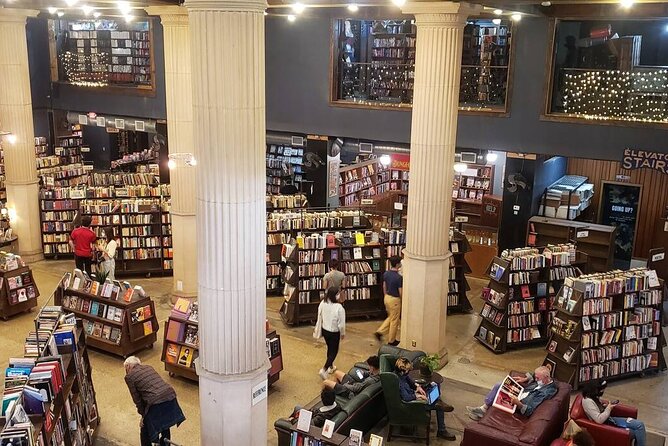
Near the end, you get a break that feels very Downtown LA in the best way: The Last Bookstore. The tour encourages you to look inside and notice details, including connections to the building’s earlier life as an old bank building and the secrets of the original vault.
This stop is a nice contrast to the earlier architecture-heavy moments. It’s still about place and history, but in a form that’s relaxed and fun. Plus, it’s a solid photo spot if you like documenting the day.
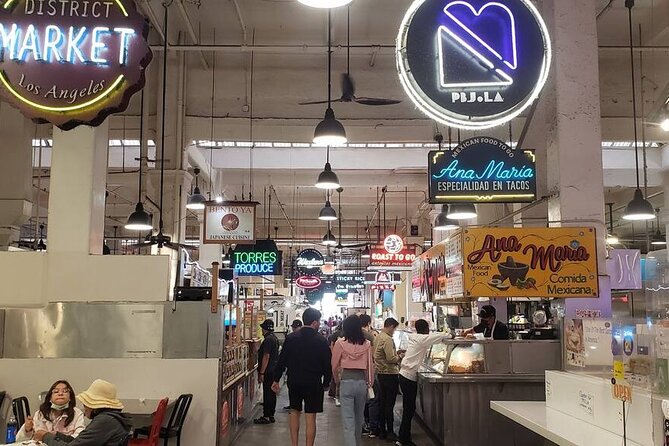
Then you wrap up at Grand Central Market, a historic food hall operating for over 100 years. The practical value here is obvious: it’s a chance to keep eating and talking without needing a reservation plan. If you’re building a longer Downtown itinerary for the rest of your day, this is a natural anchor.
Food is where a walking tour turns from education into memory. By the time you reach the market, the day’s stories have a place to land.
Price, pacing, and what $39.20 buys you in 3 hours
At $39.20 per person for about 3 hours, this tour is priced in a way that makes sense for a first pass through Downtown LA. You’re not paying mostly for “viewing.” You’re paying for direction: route planning, historical context, and the ability to hit multiple major areas without guessing where to go next.
Value comes from a few concrete things:
- Angels Flight is included, which removes a ticket decision at the start
- Several major art stops (MOCA and The Broad) are free admissions, so you’re not stacking museum fees
- Little Tokyo’s food moment is included, adding an edible takeaway instead of just photos
- The group size caps at 15, which keeps conversations realistic and questions answerable
Pacing matters too. The tour time is set to keep you moving between sites but with enough stops that you don’t feel like you’re sprinting from one landmark to the next. You’ll also get shade breaks as needed, which matters in LA heat.
One practical tip: the tour works best with good weather, and Downtown can be sunny fast. Bring water, and consider a hat—your comfort budget is worth protecting.
Who should book this Downtown LA architecture and history tour
I’d point you toward this tour if you:
- want a coherent walk through Downtown LA without turning the day into random rideshare hops
- care about architecture and want connections between buildings, neighborhoods, and city growth
- like food stops that teach you something about the neighborhood (Little Tokyo’s mochi moment does this well)
- enjoy asking questions and getting stories that explain what you’re seeing
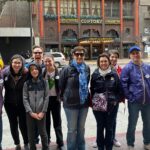
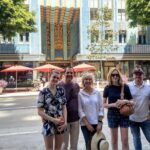
It’s also a good match for couples and solo travelers. Reviews highlight that the guide has a warm, approachable style, brings humor, and uses visuals to explain details. If you’re the type who gets annoyed by stiff tours, the tone here seems built to feel human.
If you only want celebrity photo spots or a quick hit list, this may feel too focused on history and design. But if you want Downtown to make sense, it’s a strong place to start.
Should you book it?
Yes—book it if your goal is to understand Downtown LA beyond the obvious skyline shots. This tour gives you a smart route through the Historic Core, Bunker Hill, Civic Center, and Little Tokyo, and it’s heavy on places you can’t easily interpret alone: Angels Flight’s context, the logic of free art stops in Bunker Hill, Frank Gehry’s design story, and the way Spring St’s bank district reads like a street-level timeline.
I’d only hesitate if you’re very mobility-limited or hate walking in heat. Otherwise, it’s one of the better ways to get your bearings fast and leave with a clearer picture of how LA actually formed.
FAQ
How long is the Downtown Los Angeles history and architecture tour?
It runs for about 3 hours.
How much does the tour cost?
The price is $39.20 per person.
What’s included in the tour?
Angels Flight Railway is included at the start. You also get a traditional Japanese snack in Little Tokyo from Fugetsu-Do.
Are there any admission fees during the tour?
MOCA and The Broad are listed as free admissions on the tour. Other stops are also listed with free admission tickets, except for Angels Flight, which is included.
Where does the tour meet?
The meeting point is 341 S Hill St, Los Angeles, CA 90013, and it ends back at the same meeting point.
What language is the tour offered in?
The tour is offered in English.
Is it a small group?
Yes. The maximum group size is 15 travelers.
Is the tour weather-dependent?
Yes. The experience requires good weather. If it’s canceled due to poor weather, you’ll be offered a different date or a full refund.