REVIEW · LOS ANGELES
Downtown Los Angeles: A Self-Guided Audio Tour
Book on Viator →Operated by VoiceMap Audio Tours · Bookable on Viator
Downtown LA sounds different when you walk. This self-guided VoiceMap app tour pairs landmark-by-landmark audio with offline access so you can stay independent while still guided. I like that you get lifetime access (so you can redo it later), and I like how the route strings together major Downtown sights you can actually see in one continuous walk. One possible drawback: the directions can be confusing at a couple of sidewalk choices, so you’ll want to slow down and check the map when you’re faced with two options.
You start at Pershing Square and finish at Grand Central Market in about 2 to 2.5 hours of walking. It’s designed for Android and iOS, and you’ll receive offline audio, maps, and geodata, which is a big plus in areas where signal can be spotty.
In This Review
- Key highlights worth your time
- How the VoiceMap audio walk keeps you in control
- Price and value: $14.99 for a long-lasting walking plan
- Start point at Pershing Square: an easy entry to Downtown
- From the Oscars connection to the Central Library fire story
- Bunker Hill Steps and Angels Flight: the walking set-pieces
- MOCA and The Broad: modern art without museum ticket pressure
- Walk Disney Concert Hall to Grand Park: Frank Gehry and City Hall views
- Cathedral of Our Lady of the Angels and the Bradbury Building finish
- Grand Central Market end point: where you actually linger
- When this walk is a great idea (and when it isn’t)
- Should you book this Downtown LA audio tour?
- FAQ
- How much does the Downtown Los Angeles audio tour cost?
- How long does the tour take?
- What do I need to listen to the tour?
- Can I use it without an internet connection?
- Where does the tour start and end?
- Is this tour refundable or changeable after booking?
Key highlights worth your time
- Lifetime access in English means you can come back and replay it anytime
- Offline audio + offline maps/geodata helps you keep moving even with weak service
- A landmark-heavy route on foot: from Pershing Square all the way to Grand Central Market
- Stories you can picture at real places, like the Millennium Biltmore’s Beatles and Al Capone ties
- Fun walking set-pieces: Bunker Hill Steps (Spanish Steps-inspired) and Angels Flight (the world’s shortest railway)
- Flexible pacing, with navigation that can correct you fast if you turn the wrong way, though not always perfectly
How the VoiceMap audio walk keeps you in control
This is a self-guided Downtown LA route, so you control the pace. The audio is timed to where you are, and the app helps you find each stop without needing a live guide standing over you. That’s ideal if you like moving when you feel like it, pausing for photos, or lingering when a corner feels more interesting than expected.
What I like most is the mix of guidance and freedom. The narration is there when you need context (who built what, why a place matters, what you’re looking at), but you’re not locked into a rigid group schedule. It’s also built to work without constant cell service, thanks to offline access to audio, maps, and geodata.
Still, Downtown can be confusing when streets and sidewalks braid together. One of the main complaints is not the audio itself, but the map directions. So go in with the mindset that you’re doing a walk in a dense city grid, not a guided stroll where someone will catch you if you miss a turn.
You can also read our reviews of more guided tours in Los Angeles


Price and value: $14.99 for a long-lasting walking plan
At $14.99 per person, you’re paying for an audio tour experience powered by the VoiceMap app, not for museum tickets or transportation. That actually makes the math easier: you’re getting 2 to 2.5 hours of guided walking plus offline planning tools.
The big value booster is lifetime access. If you buy it once, you can use it again later, or re-walk the parts you liked. That matters in Los Angeles, where your interests can shift fast. One year you might care most about architecture; another year you might want more design and public spaces.
Also, because the tour includes offline audio and offline navigation data, you’re less dependent on roaming charges or weak reception. For a Downtown walk, that can be the difference between a smooth experience and a frustrating one.
Just keep one expectation clear: the tour doesn’t include tickets, food, a smartphone, or headphones, and it doesn’t provide transportation. You’ll be bringing your own device and listening setup, and you’ll likely grab snacks at your own pace when you reach the market.
Start point at Pershing Square: an easy entry to Downtown
The tour begins at Pershing Square (532 S Olive St), and the narration starts by framing Downtown LA’s story. Pershing Square is also described as the oldest park in the city, which is a clever way to begin: you’re starting with a place that helps you read the neighborhood around it.
Another practical benefit at the start is orientation. You’ll hear how to take the tour using the VoiceMap app, which sets you up to trust the sequence as you move. This matters because the walk later includes several blocks where you’ll be relying on the app more than intuition.
If you want the smoothest start, give yourself a few minutes before you press play. Get your headphones connected, check that your offline download is ready, then start walking when you’re calm. Downtown is busy enough that rushing at the beginning can make navigation harder later.
From the Oscars connection to the Central Library fire story
After Pershing Square, the route threads through some of Downtown LA’s recognizable landmarks.
First stop that stands out: the Millennium Biltmore Hotel, described as the original home of the Oscars. The narration connects the hotel to the Beatles and Al Capone, which gives you a fun contrast right away—glamour, music, and organized crime all tied to a single address. Even if you’re not a movie buff, that kind of story helps you look up at the building instead of just passing by it.
Next you’ll pass the Standard Downtown. You’ll get building history while you walk, which is useful because it turns an everyday street-level view into something with a timeline. Without the audio, you might just read it as another Downtown facade. With the narration, it becomes part of the district’s evolution.
Then comes the Los Angeles Central Library, where you’ll hear the story behind the library’s fiery fate. That’s the type of moment where audio does real work: it gives you the “why” behind what you’re seeing. And because you’re walking, you can look at details in the moment rather than trying to remember them later.
At this stage of the walk, you’ll likely notice something: the route is designed to keep you moving while still slowing down at meaning. That balance is one of the reasons this type of tour can be satisfying—your attention stays on what’s around you, not just on a screen.
Bunker Hill Steps and Angels Flight: the walking set-pieces
Now you get two of the most memorable walking moments on the route.
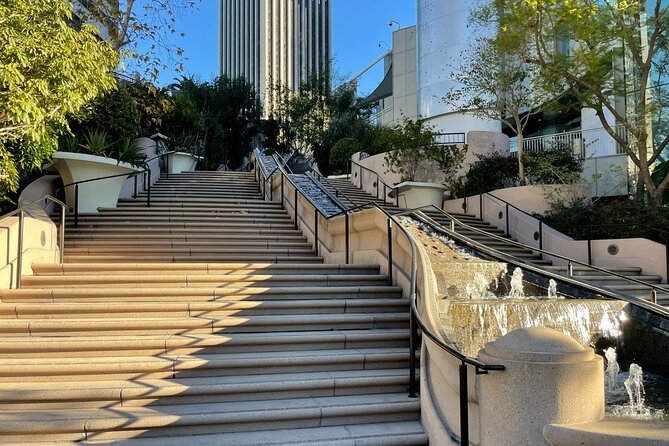
The tour takes you up the Bunker Hill Steps, and the narration explains they’re modeled after the Spanish Steps in Rome. That detail turns a climb into a connection. Even if you’ve never been to Rome, the mental picture helps you understand why these steps are treated like more than just stairs.
Right after that, you’ll pass Angels Flight, described as the world’s shortest railway. You’ll hear about it while you walk by, and the best part is the contrast with the steps. Instead of a long uphill effort, you see this compact funicular-style landmark that feels like a quirky Downtown shortcut.
If you’re thinking about when to do this section, aim for a pace you can sustain. Steps can add strain fast, especially if you’re carrying a bag. And if you prefer flat walking, this part is a good reminder that this is a real walking route, not a tram itinerary.
You can also read our reviews of more tours and experiences in Los Angeles





MOCA and The Broad: modern art without museum ticket pressure

From here, the walk moves into the modern-art and design world.
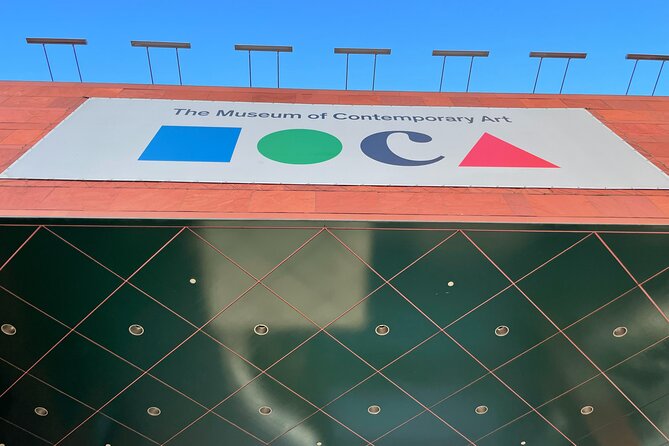
You’ll pass the Museum of Contemporary Art (MOCA), with narration you can take in while you’re on the move. The route doesn’t include tickets, so you’re not being pressured to enter. Instead, you’re using the audio as a way to understand why the area matters and what the buildings represent.
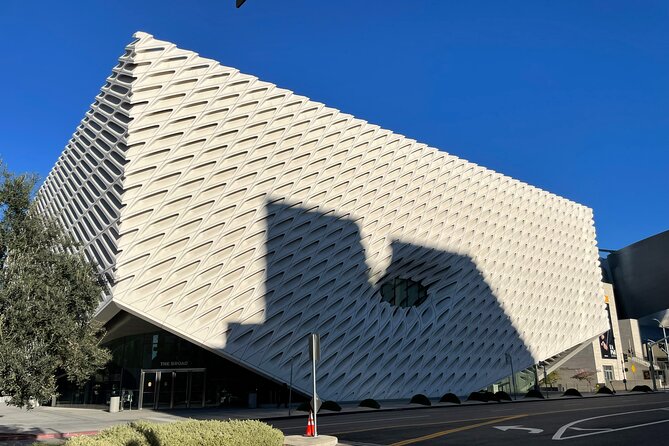
Then you’ll pass The Broad, where you’ll hear about the bold design of the contemporary art museum. This is a great example of how an audio tour can make you a better observer. When you see a striking facade in daylight, you often wonder what the point is. The narration gives you that “what you’re looking at” context so the architecture lands better.
One thing to keep in mind: if you strongly prefer inside-the-museum time, you’ll probably want to pair this walk with extra stops on your own. But if you like stepping out, reading the city, and keeping it moving, this part of the route is a strong fit.
Walk Disney Concert Hall to Grand Park: Frank Gehry and City Hall views
This is where the walk leans into Los Angeles design.
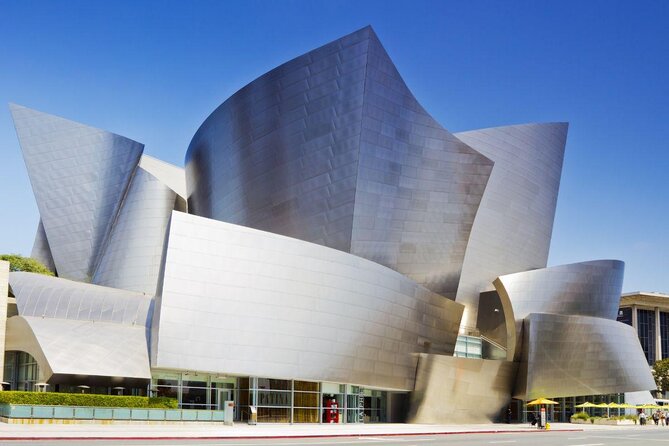
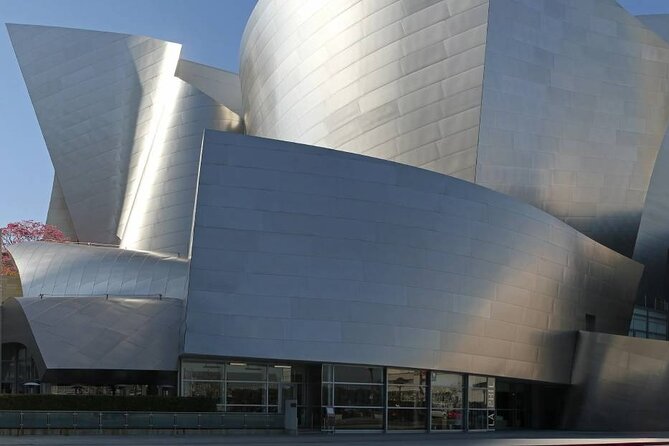
You’ll pass the Walk Disney Concert Hall, described as having the steely look of Frank Gehry’s work. You’ll see that instantly when you catch it from the right angle, and the narration helps you appreciate the style rather than just notice it as a famous building.
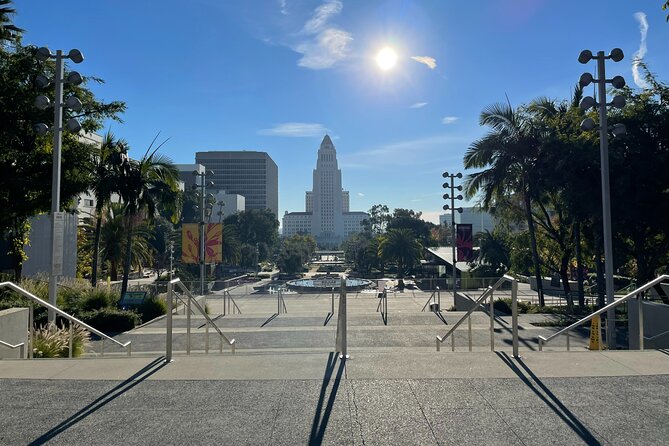
Next you’ll be guided through parts of Grand Park, including a mention of a perfect view of City Hall. That’s a key moment for your photos. The point isn’t just to stop and snap—it’s to use the park as a visual breather between denser streets.
If you’ve ever felt like Downtown LA can be hard to read, this section helps. You’re moving from iconic structures to a public green space where the sightlines open up. That’s a smart design choice for an audio walking route.
Cathedral of Our Lady of the Angels and the Bradbury Building finish
As you move toward the end, the walk shifts from contemporary design to landmark storytelling.
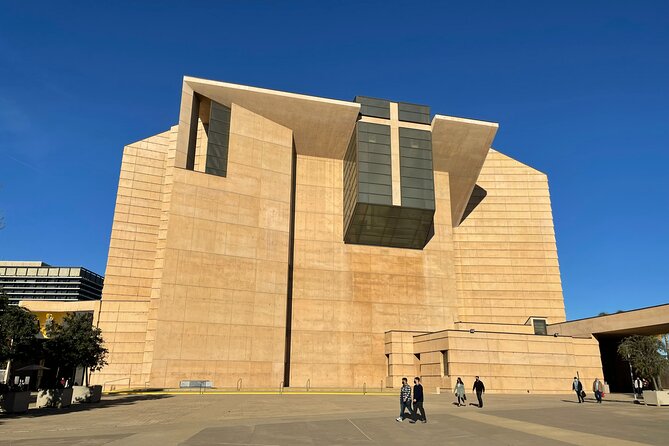
You’ll pass the Cathedral of Our Lady of the Angels, described as the second largest Catholic church in the United States. You’ll hear about it while passing, which gives the place weight even if you don’t step inside.
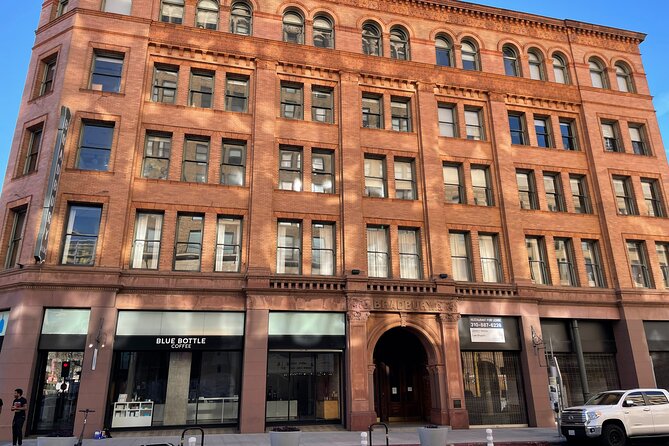
Then you’ll come to the Bradbury Building. You’ll get a bit of the building’s history while you walk. Even without extra time in the building, this type of stop is valuable because the Bradbury is one of those LA addresses people reference for a reason. The audio helps you connect that reputation to the structure in front of you.
From there, the route carries you to its final destination: the food-and-stroll payoff at Grand Central Market.
Grand Central Market end point: where you actually linger
The tour ends at Grand Central Market (317 S Broadway), described as the largest public market in the city. This is a smart ending. After a couple hours of walking and listening, you’re naturally ready for a break—and you can choose your own local meal without fitting into a tour schedule.
The market being the end point also means you can treat the audio tour like a set-up act. When you reach the stalls and lines, you’re done with navigation. You can relax, eat, and re-plan your evening with more confidence.
The market is listed as open 12:00 AM to 11:59 PM, Monday through Sunday for the validity range given. So you’re not locking yourself into a narrow end-time window, which is helpful in a city where plans often shift.
When this walk is a great idea (and when it isn’t)
This tour works especially well if you want guided context without joining a formal group. It’s also a good choice if you like the idea of repeating a route later, since the lifetime access means you’re not buying a one-time experience.
It’s also a solid fit if you want to see Downtown through a lens of stories—Oscars-era LA, the Oscars hosting location at the Millennium Biltmore Hotel, the steps inspired by Rome, and the design language tied to places like Frank Gehry’s concert hall.
On the flip side, Downtown LA isn’t everyone’s comfort zone. One common sentiment is that the streets can feel dreary, so if you need scenic, easygoing walking every minute, this might not match your vibe. Also, if you struggle with self-navigation, the route’s directions can be a frustration point. The good news: the mapping can correct wrong turns quickly. The caution: there can be moments where you have to choose between sidewalks, and picking the wrong one may cost you time.
So I’d treat this as a great half-day plan if you’re building an LA itinerary around neighborhoods and architecture. If you only have one day and you want the most effortless sightseeing possible, you may want to pick a simpler route.
Should you book this Downtown LA audio tour?
Book it if you:
- Want offline audio and maps and you plan to walk Downtown
- Like getting story context at each stop without paying for separate tickets
- Appreciate lifetime access, so you can replay or revisit later
Skip it or reconsider if you:
- Prefer fully hosted, error-proof directions at every turn
- Want a more scenic, walk-every-minute experience
- Don’t want to bring your own smartphone and headphones
If you’re the type who enjoys making your way through a city with a plan, this tour’s value is hard to beat: $14.99 buys you a repeatable Downtown LA walking script, plus the tools to keep you moving smoothly from Pershing Square to Grand Central Market.
FAQ
How much does the Downtown Los Angeles audio tour cost?
It costs $14.99 per person.
How long does the tour take?
It takes about 2 hours to 2 hours 30 minutes, depending on your pace.
What do I need to listen to the tour?
You need your own smartphone and headphones. The tour provides the VoiceMap app for Android and iOS.
Can I use it without an internet connection?
Yes. You get offline access to audio, maps, and geodata.
Where does the tour start and end?
It starts at Pershing Square, 532 S Olive St and ends at Grand Central Market, 317 S Broadway.
Is this tour refundable or changeable after booking?
No. The experience is non-refundable and cannot be changed for any reason.