REVIEW · LOS ANGELES
LA Little Tokyo to Olvera St Smartphone (App/GPS) Walking Tour
Book on Viator →Operated by WalknTours · Bookable on Viator
A street-level history story, guided by your phone. This smartphone GPS walking tour connects Little Tokyo and Olvera Street through Japanese and Chinese American history, and it lets you pause when you want a breather or a photo. I also like that the pacing is built for real walking, with clear directions that help you get back on track fast. One drawback to plan for: the narration is location-triggered, so it can start and stop as the app reaches each GPS pin.
You’re not tied to a group meeting or a live guide voice. You get a mobile ticket and audio that points you to landmarks like Japanese Village Plaza’s fire tower, City Hall’s observation deck, and Olvera Street’s marketplace layers. The tour ends at Cielito Lindo, where you can wrap up with taquitos if that’s your style, but there’s no included food or water.
In This Review
- Key highlights to know before you start
- How the LA Smartphone GPS Walk Works (and why pausing matters)
- Getting oriented at the Statue “Chiune Sugihara” on Central Ave
- Little Tokyo: Japanese LA history you can actually walk through
- Japanese Village Plaza: fire tower views and what to look for
- Fugetsu-Do Bakery Shop: the story-forward snack stop
- Los Angeles City Hall: an observation deck moment on your own schedule
- El Pueblo de Los Ángeles Historical Monument: where LA begins
- Calle Olvera and the marketplace story: Wine Street to Judge Olvera
- Cielito Lindo taquitos and why the ending works
- The main trade-offs of an app-led tour (no live guide, no included extras)
- Price and value: $7.50 for a big walking-story loop
- Who should book this LA Little Tokyo to Olvera Street GPS tour
- Should you book this GPS walk from Little Tokyo to Olvera Street?
- FAQ
- How long is the LA Little Tokyo to Olvera St smartphone walking tour?
- How much does the tour cost?
- What’s included in the experience?
- Where does the tour start and end?
- Is food included?
- Is there free cancellation?
Key highlights to know before you start
- Location-aware audio you can pause for street time, photos, and quick snack stops
- Little Tokyo focus on the Japanese story in Los Angeles, plus practical local-food stops
- Olvera Street timeline from Wine Street to Judge Augustín Olvera, then the 1930 marketplace shift
- Major LA landmarks in one loop: City Hall, El Pueblo de Los Ángeles, and Chinatown-area history outside the Chinese American Museum
- Clear back-on-track routing that helps if you do get turned around
How the LA Smartphone GPS Walk Works (and why pausing matters)
This is a self-guided walking tour using a location-aware smartphone app. You start at the Statue “Chiune Sugihara” at 192 S Central Ave, then follow GPS audio prompts from stop to stop. Expect about 1 hour to 1 hour 15 minutes for a typical walk pace, depending on how often you pause and look around.
The big value here is control. One of the most praised parts of this format is that you can pause to explore a location instead of feeling rushed by a moving group. If you want to step into a storefront window, linger for a picture at a landmark, or just stand still and read the story on your phone, you can do it. That turns the tour from a script into a walking plan you steer.
You should also know what this is not. There’s no live guide in person, no included food, and no water. The “included” part is the tour itself: the app-based directions and the story behind the buildings and neighborhoods. That means you’re in charge of your comfort: carry water, wear good shoes, and decide which optional stops are worth the detour for you.
Finally, this runs as a private experience for your group. Even though it’s app-based, you’re not being mixed into a bigger human pack. For families, friend groups, or anyone who wants to move at their own tempo, that’s a real plus.
You can also read our reviews of more walking tours in Los Angeles

Getting oriented at the Statue “Chiune Sugihara” on Central Ave
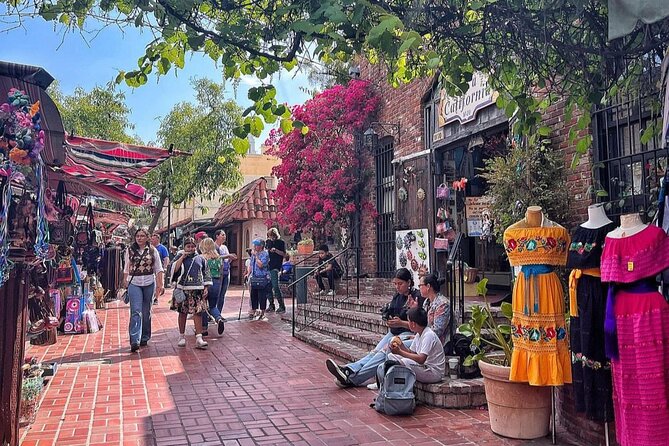
Your start point is specific: the Statue “Chiune Sugihara” at 192 S Central Ave in Los Angeles. Using a named landmark like this helps. It’s easier to find than a vague street corner, and it gives you a clear “this is where the tour begins” reference.
Because the meeting point is in the Central Ave area, you’ll likely find it easy to connect by public transportation, and the tour is described as near transit. Still, I’d recommend giving yourself a few minutes of buffer, especially if you’re arriving during busier hours or you want time to get your phone charged and your headphones ready.
Your end point is just as clear: Cielito Lindo, 23 Olvera St (the tour ends there). That matters because Olvera Street can feel like a maze of shops when you’re hungry and the crowd density goes up. Ending at a known taqueria-style landmark helps you finish without the usual “where are we supposed to meet?” stress.
Little Tokyo: Japanese LA history you can actually walk through
The tour’s Little Tokyo segment is designed to give you context fast—without needing a museum ticket. You spend about 15 minutes exploring Little Tokyo and learning about the history of Japanese people in Los Angeles.
This is the kind of audio-guided story that changes the way you see streets. Instead of treating Little Tokyo like a place to browse, you get a reason behind the buildings and street life. You learn what to notice and how to connect the neighborhood’s past to what you see today.
A big advantage of a smartphone format is the photo flexibility. When the audio points out a specific scene or detail, you can stop for it. When it’s describing something more general, you can keep walking without feeling like you’re behind schedule. That “right balance” shows up in the feedback: this tour is paced enough to stay interesting, but flexible enough that you don’t feel trapped.
If you care about food stops, this area helps too. One of the most liked pieces people mention from the Little Tokyo portion is the chance to learn about mochi and an Edo garden angle linked to the Japanese Village Plaza area. Even if you don’t buy anything, the story makes the place more readable.
Japanese Village Plaza: fire tower views and what to look for
Next comes Japanese Village Plaza, roughly 5 minutes. Here, you’re meant to look around and see the plaza features, including the fire tower, plus learn more about the area’s background.
This is a good stop for three reasons. First, it’s compact, so you’re not committing to a long detour. Second, it’s visual—fire tower landmarks are easy to orient to. Third, you’re getting history tied to a physical place, not just abstract facts.
If you like photo ops, this is where your camera will earn its keep. People especially enjoy this portion because it feels like you’re stepping into a specific themed landscape and getting pointers on what makes it meaningful.
One small practical note: because the tour is GPS-triggered, you might find that the audio updates as you move between the plaza edges. That’s normal. If you want to take longer photos, use the pause button and let the tour wait for you.
Fugetsu-Do Bakery Shop: the story-forward snack stop
Then you hit Fugetsu-Do Bakery Shop for about 5 minutes. The app frames it as one of the best bakeries, and it includes a short story about the place. It’s also described as a great place to eat.
Important reality check: food is not included in this tour. So treat this as an optional stop where you can grab something if you want, not as a guaranteed included tasting. The upside is you control the timing. If you need a break mid-walk, a bakery works. If your stomach says no, you can still enjoy the story component without spending money.
Because the tour is short at each stop, the bakery segment tends to feel efficient. You’re not stuck in a long line unless you choose to be. If you do buy something, do it early enough that you’re not juggling food while walking the next stretch.
You can also read our reviews of more tours and experiences in Los Angeles




Los Angeles City Hall: an observation deck moment on your own schedule
City Hall is one of the “big city” landmarks on this route, with about 10 minutes devoted to it. The audio covers the construction story and gives you a chance to get a view from the observation deck.
This stop is valuable even if you’re not a self-described architecture nerd. Why? Because it turns a recognizable building into a story you can recall later. You’ll likely find yourself looking up more than you expected, and that’s exactly what you want from an audio tour.
The observation deck part is a bonus, but plan for logistics on your end. The tour data here doesn’t spell out how long the line might be or whether you’ll need time on-site, so treat this as the stop that may slow you down the most if you decide to go up.
If you’re sensitive to crowds, consider your timing. City Hall areas can get busy, and the tour’s real advantage is that it lets you pause and adjust your pace.
El Pueblo de Los Ángeles Historical Monument: where LA begins
After that, you’ll reach El Pueblo de Los Ángeles Historical Monument, about 10 minutes. This is framed as the site where Los Angeles began, with audio focused on the story behind the naming and what you can see in the historic park.
This is a great stop for people who like a mix of “place + meaning.” You’re not just passing through; you’re learning the names, the origin story, and how the area connects to the city’s identity. And since it’s a walking tour, the learning stays attached to the exact spot you’re standing in.
A practical tip: keep your phone volume comfortable. The park environment can have sound carry from nearby streets, and good audio helps you catch the specifics the first time.
You may also encounter the tour prompt near the Chinese American Museum area, where the audio goes outside the usual postcard narrative and discusses the Chinese riot and murders and the history of Chinese in Los Angeles. That’s a serious topic, so I’d treat it as a reflective moment, not a quick background listen.
Calle Olvera and the marketplace story: Wine Street to Judge Olvera
Then the tour shifts toward Olvera Street with Calle Olvera, about 10 minutes. You’ll learn that Olvera Street was originally known as Wine Street, then renamed in 1877 in honor of Judge Augustín Olvera, who was the first elected county judge in Los Angeles. The audio also covers how, in 1930, local merchants shaped the colorful marketplace that runs today.
This stop is where the tour becomes especially fun for casual walkers. You get a clear timeline, but you also get permission to look around. Instead of thinking of Olvera Street as only a place to shop, you start recognizing it as a layered place with shifts in purpose over time.
A lot of people come here hungry. Just remember: the tour itself does not include food, water, or entry. If you want snacks, plan to buy them on your own at the moments that feel right.
Also, because the tour ends later at Cielito Lindo, you can treat Calle Olvera as your “browse and absorb” portion. You can window-shop, read signs, and keep your energy for the final taquito payoff.
Cielito Lindo taquitos and why the ending works
The tour’s end is at Cielito Lindo on Olvera Street. This is listed as about 5 minutes, but the real point is what happens after the audio finishes: you’re standing at a historic street taquito spot.
The audio tells the story of how the taquito stand was started and how the food is made, and it ties the ending to the wider story of Olvera Street’s festive atmosphere.
This ending is smart for two reasons. One, it gives you a built-in finish line after a route packed with history and landmarks. Two, it offers an easy reward if you want one, without pretending a meal is part of the tour ticket.
If you’re traveling with people who want photos and people who want stories, this is one of the few endings in LA that makes both groups happy. You can keep browsing after the audio stops, but you’ll at least have a shared context for why Olvera Street feels the way it does.
The main trade-offs of an app-led tour (no live guide, no included extras)
Because there’s no person guiding you, you’re trading human improvisation for independence. That can be great, but it has limits.
What’s covered: location-aware directions and narrated stories tied to specific landmarks, including Japanese and Chinese American history, plus key LA sites like City Hall and the El Pueblo monument.
What’s not covered: no food, no water, no entrance, and no people as part of the tour package. Even where the data lists admission tickets as free for certain stops, you still need to manage your own costs for anything you buy or any access that might require separate handling on-site.
Also, GPS-driven tours can be a little “stop and start.” One of the points from feedback is a desire to listen to the entire narration without interruption at each GPS location. If you like to keep a continuous audio stream, you might find the pin-based pauses slightly annoying. The workaround is simple: when a stop doesn’t matter for you, you can move quickly and let the audio catch up, or you can pause manually and restart when you’re ready.
Finally, the narration is in English, and that’s the only language listed. If you need another language, you’d want to confirm availability before booking.
Price and value: $7.50 for a big walking-story loop
At $7.50 per person, this is one of the cheaper ways to build a meaningful LA day without signing up for a full guided tour. The value isn’t just the cost. It’s that you get a route connecting multiple neighborhoods and major landmarks in one pass: Little Tokyo, Japanese Village Plaza, City Hall, El Pueblo, and then Olvera Street.
You’re paying for:
- the guided structure (so you don’t have to plan every stop)
- the storytelling tied to what you’re seeing
- the ability to go at your pace, including pausing
You’re not paying for:
- a guide’s extra context beyond the app
- museum entry included as part of your ticket
- a snack or meal as part of the experience
If you’re the kind of traveler who likes to learn while walking, this price makes sense. If you hate walking, hate using your phone as the “guide,” or want a human to answer questions, you may feel under-served.
Who should book this LA Little Tokyo to Olvera Street GPS tour
This is a strong fit if you:
- like history that’s tied to real streets, not only indoor exhibits
- want flexible pacing and the option to stop for photos or food
- prefer a structured route but don’t want to follow a group
- enjoy a mix of architecture/landmarks and neighborhood stories
It may not be the best fit if you:
- want a continuous narration experience with no GPS interruptions
- need lots of in-the-moment help from a live person
- plan to rely on the tour for included snacks or water
Should you book this GPS walk from Little Tokyo to Olvera Street?
I’d book it if you want a low-cost way to connect Japanese LA and Chinese LA stories with the iconic sights of City Hall and El Pueblo, then finish with a practical food stop at Cielito Lindo. The ability to pause and explore without feeling rushed is the headline feature, and it’s exactly what makes this kind of tour work.
If you’re booking with someone who loves photography and someone who loves history, this layout also helps. You get both: fire tower visuals, City Hall viewpoints, and marketplace backstory. Just bring the basics (water, comfortable shoes), and accept that the audio is controlled by your GPS pins.
If that trade-off sounds fair, you’ll likely enjoy the day.
FAQ
How long is the LA Little Tokyo to Olvera St smartphone walking tour?
The tour is listed as about 1 hour to 1 hour 15 minutes.
How much does the tour cost?
It costs $7.50 per person.
What’s included in the experience?
You get a location-aware smart phone APP walking tour with narrated stories tied to historic areas of Los Angeles.
Where does the tour start and end?
It starts at the Statue “Chiune Sugihara”, 192 S Central Ave, Los Angeles, CA 90012, and ends at Cielito Lindo, 23 Olvera St, Los Angeles, CA 90012.
Is food included?
No. The tour does not include food or water. The app includes stops like Fugetsu-Do Bakery and an ending at Cielito Lindo, but you’d buy anything you want on your own.
Is there free cancellation?
Yes, you can cancel for a full refund up to 24 hours in advance of the experience start time. If you cancel less than 24 hours before, the amount paid is not refunded.